Partners
Asian Institute of Maritime Studies
College of Our Lady of Mercy of Pulilan Foundation, Inc.
Immaculate Conception College of Balayan, Inc.
Meycauayan College
Zamboanga Peninsula Polytechnic State University
University of Caloocan City
Metro Manila College Novaliches
College of Subic Montessori
MYA House of Achievers
Reading Clinique
Asian Institute of Maritime Studies
College of Our Lady of Mercy of Pulilan Foundation, Inc.
Immaculate Conception College of Balayan, Inc.
Meycauayan College
Zamboanga Peninsula Polytechnic State University
University of Caloocan City
Metro Manila College Novaliches
College of Subic Montessori
MYA House of Achievers
Reading Clinique
GET International
Home About Courses
Message of the President Message of the Vice President Message of the Secretary Peer Reviewers
Institutional Membership Individual Professional Membership
Research Magazines News
Login Register
Home About Courses
Administration Message of the President Message of the Vice President Message of the Secretary Peer Reviewers
Linkages Institutional Membership Individual Professional Membership
Research Magazines News
Login Register
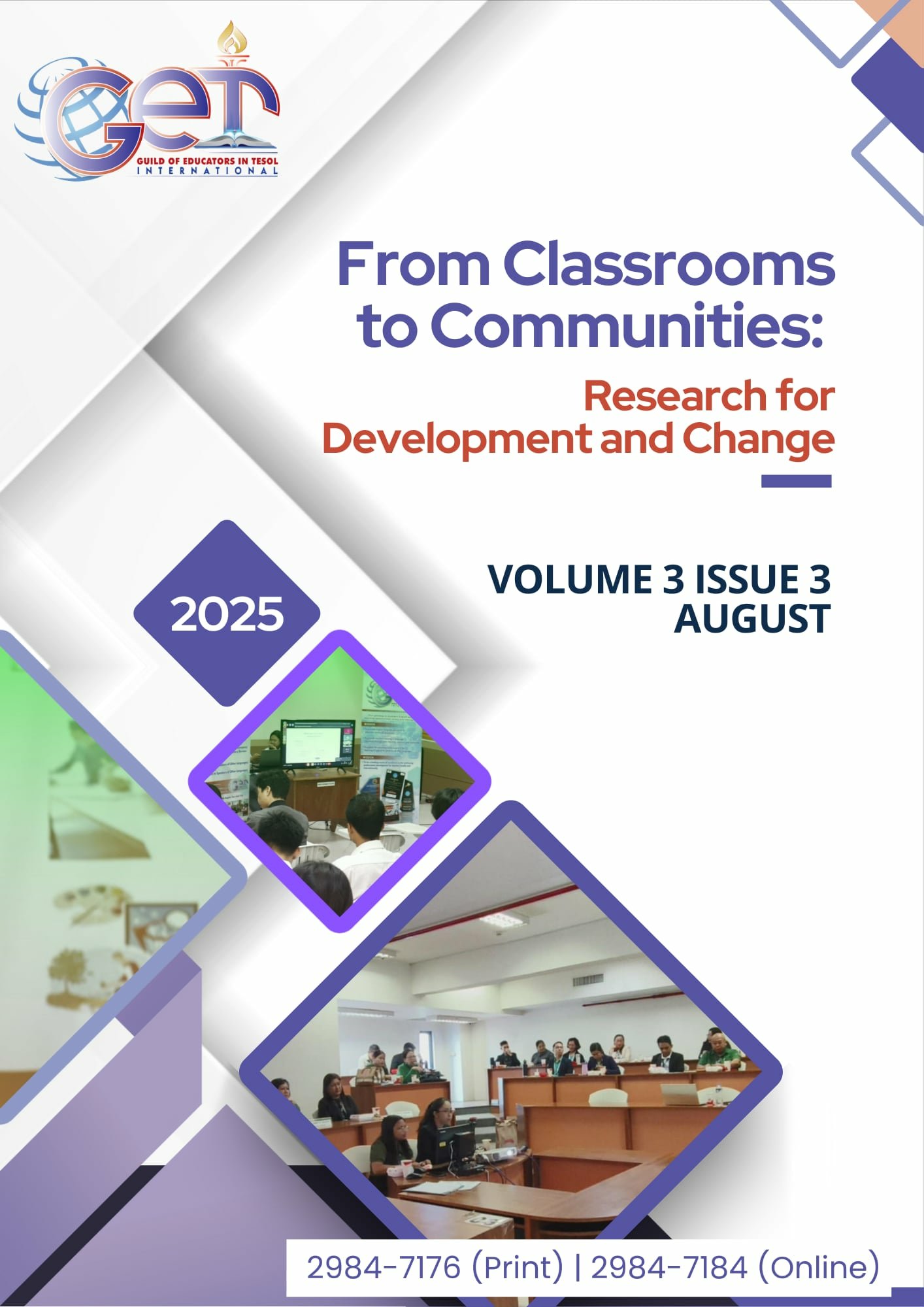
Vol. 3, Issue 3

Vol. 3, Issue 3

Volume 3 Issue 3 August 25, 2025
8 research paper(s) in this journal

Published Research Papers

THE PHILIPPINE SECONDARY PUBLIC-SCHOOL TEACHERS DIGITAL COMPETENCE BASED ON THE EUROPEAN FRAMEWORK: A PROPOSED TRAINING PROGRAM

Author(s): Minalin Serbito Valeda, Edward L. Padama

M.B. Asistio Sr. High School, Arellano University, Legarda Manila Campus

Abstract

To advance and innovate the 21st-century classroom, a strong determination is required to provide instructors with the opportunity to learn and implement innovative pedagogical practices and digital resources that enhance students' learning experiences. This study intends to assess the master teachers' digital competence based on the DigCompEdu framework of the European Union, which sets international best practices (Redecker, 2017).  Twenty master teachers from the AROMAR District of Caloocan City, representing 100% of the total, took part in this quantitative study. The study used a questionnaire that was directly taken from the SELFIE for Teachers of the European Framework for Digital Competence of Educators (European Commission, 2017; Redecker, 2017; European Commission, 2022). The study utilized basic statistics, including mean and percentage, to assess the digital competency of respondents and establish the foundation for an appropriate digital training program for secondary master teachers in public schools. The results showed that most respondents were categorized as "explorers," leading to a notable outcome and a strong need for improving their digital skills (Redecker, 2017; European Commission, 2022).

Keywords

Teachers' Digital Competence Innovative Pedagogies Digital Training Program Digital Advancement Digital Resources

Citation

Valeda, M. S., & Padama, E. L. (2025). THE PHILIPPINE SECONDARY PUBLIC-SCHOOL TEACHERS DIGITAL COMPETENCE BASED ON THE EUROPEAN FRAMEWORK: A PROPOSED TRAINING PROGRAM. GET INTERNATIONAL RESEARCH JOURNAL, 3(3), 1–17. https://doi.org/10.5281/zenodo.17005303

DOI: 10.5281/zenodo.17005303 Download PDF

WORK VALUES AND CLASSROOM PRACTICES OF CAS FACULTY: PROSPECT FOR FACULTY DEVELOPMENT PROGRAM

Author(s): Michael C. Hermogenes, Irene B. Magistrado, Edward L. Padama

Arellano University - Legarda, Manila Campus

Abstract

 This study looked at how students thought about the work ideals and classroom practices of faculty members in the College of Arts and Sciences (CAS). The goal was to help create a faculty development framework that improves both character and competence. Using a descriptive research methodology, data were collected from students who filled out a validated questionnaire about forty (40) faculty members during the 2020-2021 school year. The results showed most of the faculty members were women, had master’s degrees, and got good performance evaluations.  The highest mean scores for the nine work values were for being fair, loyal, and hard-working. This shows that the values are very similar to each other. In general, faculty members consistently followed fundamental work values. However, there were big disparities when they were classified by gender and teaching performance, but not by highest level of education. Based on these results, a values-based faculty development program was suggested to strengthen professional values including justice, loyalty, hard work, and others through reflective, collaborative, and gender-sensitive methods. The program aims to improve moral behavior, make lessons more successful, and encourage teachers to consider themselves as people who value honesty and putting students first.

Keywords

Work values Classroom practices Faculty development Competence Character Higher education Teacher ethics

Citation

Hermogenes, M. C., Magistrado, I. B., & Padama, E. L. (2025). WORK VALUES AND CLASSROOM PRACTICES OF CAS FACULTY: PROSPECT FOR FACULTY DEVELOPMENT PROGRAM. GET INTERNATIONAL RESEARCH JOURNAL, 3(3), 18–25. https://doi.org/10.5281/zenodo.17007214

DOI: 10.5281/zenodo.17007214 Download PDF

INTEGRATION OF GHATGPT IN NURSING EDUCATION: A NARRATIVE REVIEW

Author(s): Dennis C. Fronda, Sammy Q. Dolba, Emeliza J. Fronda

Far Eastern University, Philippines, Arellano University, Philippines

Abstract

Incorporating artificial intelligence (AI)—primarily generative AI—into nursing education represents a significant shift in the way student nurses learn. In this narrative review, we summarize where ChatGPT, a complex AI language model created by OpenAI, sits in nursing education today. In fact, ChatGPT in education is growing, and is being used more often to enhance students learning processes. This AI chatbot generates text that would be similar to the course of a human conversation. It provides personalized tutoring, addresses challenging questions and helps with mock case studies. However, ChatGPT integration to nursing education faces some barriers. With constantly changing things, ChatGPT's information can be inconsistent. There is a constant need for updates (which keep pace with current standards) and one fear is that human interaction will be less frequent. Ethical problems on its use and place in complex educational content also is discussed along with the need for overall supervision. Overall, the review highlights that ChatGPT has great potential for improving nursing education; however, it must be carefully planned for and monitored to the extent possible. Much more needs to be done to know how ChatGPT shapes nursing education. Integration of ChatGPT into nursing education has benefits in terms of ease of use, personal learning and clinical reasoning. This AI tool complements the educators in providing more support, promotes interdepartmental collaboration, and helps educators overcome resource constraint through scalable and low cost AI tool. As nursing education continues to evolve, responsible integration of AI tools, such as ChatGPT, will become essential in progress and also improved patient outcomes associated with nursing education.

Keywords

ChatGPT AI nursing education

Citation

Fronda, D. C., Dolba, S. Q., & Fronda, E. J. (2025). INTEGRATION OF GHATGPT IN NURSING EDUCATION: A NARRATIVE REVIEW. GET INTERNATIONAL RESEARCH JOURNAL, 3(3), 26–42. https://doi.org/10.5281/zenodo.17008239

DOI: 10.5281/zenodo.17008239 Download PDF

AWARENESS IN DATA PRIVACY LAW AMONG BPA STUDENTS ITS RELATION TO ONLINE CLASS MODALITY

Author(s): Jackylin Gutierrez Pido

Eulogio “AMANG” Rodriguez Institute of Science and Technology, Nagtahan, Sampaloc, Manila

Abstract

In the current generation, it is crucial for everyone to be aware of the significance of data privacy awareness. It is essential for everyone to be aware of what information is being collected and how it will be beneficial to other people. In today's modern society, practically everyone, including the younger generation, has their own electronic devices. It is likely that this has not taken into account the impact of the epidemic, which has caused us to become reliant on utilizing various technologies that are currently available. This study raises awareness among all individuals about the importance of protecting their privacy and preventing the disclosure of personal information. Within the scope of this investigation, the descriptive research method that was employed and utilized was the probability sampling approach, specifically the simple random sample method, which was employed to characterize the interrelationships between the various variables. The outcomes of the research indicate that there is a high level of awareness in data privacy legislation on the online class modality, and that there is a high level of understanding in data privacy law among BPA students and faculty members. The findings of this study highlight the significance of educating BPA students and faculty members about the value of protecting their personal information as we continue to explore the possibility of earning through online means.

Keywords

Data Privacy Act 2012 Privacy Awareness Online Modality Personal Data Surfing Internet Safely Video Conference Removing Data Traces

Citation

Pido, J. G. (2025). AWARENESS IN DATA PRIVACY LAW AMONG BPA STUDENTS ITS RELATION TO ONLINE CLASS MODALITY. GET INTERNATIONAL RESEARCH JOURNAL, 3(3), 43–52. https://doi.org/10.5281/zenodo.17008309

DOI: 10.5281/zenodo.17008309 Download PDF

A TRANSITIVITY ANALYSIS OF PRESIDENT AQUINO'S INTERNATIONAL NEWS INTERVIEW ON THE TYPHOON YOLANDA DISASTER

Author(s): Eduardo Teodoro B. Ramos, Jr., Cecilia F. Genuino

Arellano University, Philippine Normal University-Manila

Abstract

The late former Philippine president Benigno Simeon C. Aquino III has been known for his diplomatic, cordial demeanor and deliberate explanation of issues whenever he would speak either in front of audiences as guest speaker or on television and/or radio as an interviewee. He is also remembered for his straightforward and deliberate yet polite replies as well as his wry humor, which he would deliver in Filipino especially when interacting with audiences who are composed of either civil servants or the general public. The study explored the various transitivity processes in the context of his worldwide interview with renowned British-Iranian broadcast journalist Christiane Amanpour, which focused on the effects of Typhoon Yolanda and the government’s disaster response. The interview was part of Ms. Amanpour’s program on the international edition of Cable News Network (CNN). Ramos utilized as his theoretical framework the Transitivity Analysis Theory by Halliday (in Halliday & Matthiesen, 2014). The overall results of the research revealed that material and relational processes were the most prevalent of all transitivity processes. In terms of personality and ideology, it was revealed that President Aquino reflected inclusivity and forthrightness as two of his dominant characteristics.  The current study recommends that political interviews in the vernacular be utilized for further research on transitivity analysis and that a series of broadcasted interviews by the same president or other contemporary presidents serve as data to determine patterns in terms of transitivity processes as well as indicators of personality and political ideologies.

Keywords

Discourse analysis Media discourse Political discourse Systemic functional linguistics Transitivity analysis

Citation

Ramos Jr., E. T. B., & Genuino, C. F. (2025). A TRANSITIVITY ANALYSIS OF PRESIDENT AQUINO'S INTERNATIONAL NEWS INTERVIEW ON THE TYPHOON YOLANDA DISASTER. GET INTERNATIONAL RESEARCH JOURNAL, 3(3), 53–63. https://doi.org/10.5281/zenodo.17008398

DOI: 10.5281/zenodo.17008398 Download PDF

PERLOCUTIONARY ACTS AND COOPERATIVE PRINCIPLE ADHERENCE IN SELECTED PHILIPPINE PUBLIC SERVICE INTERVIEWS

Author(s): Eduardo Teodoro B. Ramos, Jr.

Arellano University

Abstract

Public service programs have been prevalent in Philippine broadcast media since television and began. With the prevalence of social media as part of the modernization of mass media, there are now emergent public service programs that air both on traditional media and social media. Anchored on Searle and Austin’s Speech Act Theory framework as well as Grice’s Cooperative Principle framework, the study by Ramos utilized trending interviews over “Wanted sa Radyo” as samples. It was revealed that persuasion and convincing were two of the most prevalent perlocutionary acts for both the hosts and the guests. Focusing on the Gricean maxims, the most adhered maxims were of relevance and manner; however, it was also discovered that manner also had the most violations. Further research on local public service talk shows with respect to speech acts and maxims was recommended by the author for scholars on sociolinguistics and discourse analysis.

Keywords

Cooperative Principle Critical discourse analysis Gricean maxims Media discourse Speech acts

Citation

Ramos Jr., E. T. B. (2025). PERLOCUTIONARY ACTS AND COOPERATIVE PRINCIPLE ADHERENCE IN SELECTED PHILIPPINE PUBLIC SERVICE INTERVIEWS. GET INTERNATIONAL RESEARCH JOURNAL, 3(3), 64–80. https://doi.org/10.5281/zenodo.17008424

DOI: 10.5281/zenodo.17008424 Download PDF

SOCO INVESTIGATORS' COMPETENCIES: A FRAMEWORK FOR BEST PRACTICES

Author(s): Robert Balibat Momo

Philippine College of Criminology

Abstract

This study investigated the competencies of Scene of the Crime Operatives (SOCO) investigators within the Eastern Police District Forensic Unit (EPDFU) in Metro Manila, Philippines. It developed a framework for best practices in forensic investigation. Recognizing the growing complexity of crime scene investigations and the evolving role of forensic science, this research assesses investigators’ technical capabilities, adherence to protocols, and access to forensic resources and tools. A concurrent mixed-methods design was employed, integrating quantitative data from Individual Performance Evaluation Ratings (IPER) and competency assessments with qualitative insights from semi-structured interviews to explore operational challenges. Findings reveal significant disparities in resource availability, with many investigators lacking access to modern forensic equipment and advanced training. While competencies in basic crime scene procedures were generally adequate, gaps persisted in areas requiring advanced forensic knowledge and inter-agency coordination. The study established a strong correlation between resource adequacy and investigator performance, highlighting the systemic impact of logistical and procedural limitations on evidence handling and crime resolution. This research contributes to the criminology literature by contextualizing global forensic standards within local constraints, offering a practical framework for modernizing forensic operations. It underscores the importance of equipping investigators with both skills and tools to ensure credible, efficient, and timely crime scene investigations—ultimately reinforcing public trust and judicial integrity.

Keywords

SOCO investigators Forensic competencies Crime scene investigation Resource adequacy Eastern Police District Forensic Unit

Citation

Momo, R. B. (2025). SOCO INVESTIGATORS' COMPETENCIES: A FRAMEWORK FOR BEST PRACTICES. In GET INTERNATIONAL RESEARCH JOURNAL (Vol. 3, Number 3, pp. 65–224). Zenodo. https://doi.org/10.5281/zenodo.17011442

DOI: 10.5281/zenodo.17011442 Download PDF

THE USE OF BODY-WORN CAMERAS ON POLICE ACCOUNTABILITY AND PUBLIC TRUST: AN ASSESSMENT

Author(s): Soledad Legaspi Elefanio

Philippine College of Criminology

Abstract

Body-worn cameras, or BWCs, are small, wearable recording devices that allow for the actions of law enforcement to be watched, reviewed, and monitored, and thus can be used to hold police accountable for their actions and to increase the level of trust between the public and law enforcement. However, there is a lack and gap concerning how implemented BWCs affect how effective they are in enhancing police accountability, reducing crime, and building community trust in the Philippine setting. The purpose of this study was to assess the effectiveness of body-worn cameras and how they affected various factors related to public trust. A total of 288 law enforcement officers and barangay officials were randomly selected from Region 3 as respondents. Data were collected using a researcher made questionnaire and analyzed using descriptive and inferential statistics. The results indicate that BWCs are fully implemented in the region and that they are effective in promoting factors such as police accountability, reducing crime, and building trust within the community. It also indicates that the perspectives of BWCs between barangay officials and law enforcement are not too different. Further, when examining the relationship between the factors, it shows that if BWCs are properly implemented, they become very effective devices that promote and increase police accountability, reduce crime in areas, and help to build and cultivate community trust.

Keywords

Law enforcement Body-worn cameras Public trust Police accountability Crime reduction

Citation

Elefanio, S. L. (2025). THE USE OF BODY-WORN CAMERAS ON POLICE ACCOUNTABILITY AND PUBLIC TRUST: AN ASSESSMENT. In GET INTERNATIONAL RESEARCH JOURNAL (Vol. 3, Number 3, pp. 225–384). Zenodo. https://doi.org/10.5281/zenodo.17011621

DOI: 10.5281/zenodo.17011621 Download PDF
Back to All Journals

Quick Links

  • About Us
  • Contact Us
  • Courses
  • Research
  • Magazines
  • Publication Policies

Contact

  • 9036 Tinejero Brgy. Pulilan, Bulacan
  • tesol8international@gmail.com

Opening Hours

Monday - Friday:

09:00 AM - 09:00 PM

Saturday:

09:00 AM - 12:00 PM

Sunday:

Closed

Visitors

130 Total Visitors
United States US 66
Philippines PH 25
Singapore SG 7
China CN 6
South Korea KR 4
Japan JP 3
Canada CA 3
Austria AT 3
Malaysia MY 2
Australia AU 2
United Kingdom GB 1
Sweden SE 1

© 2026 GET International. All rights reserved.

Home Help Privacy Cookies Terms Refunds

We use cookies

Some are needed to run the site and keep you signed in. With your permission we also use analytics cookies to see which pages and courses are useful. Nothing optional is set unless you accept. Read our Cookie Policy and Privacy Policy.